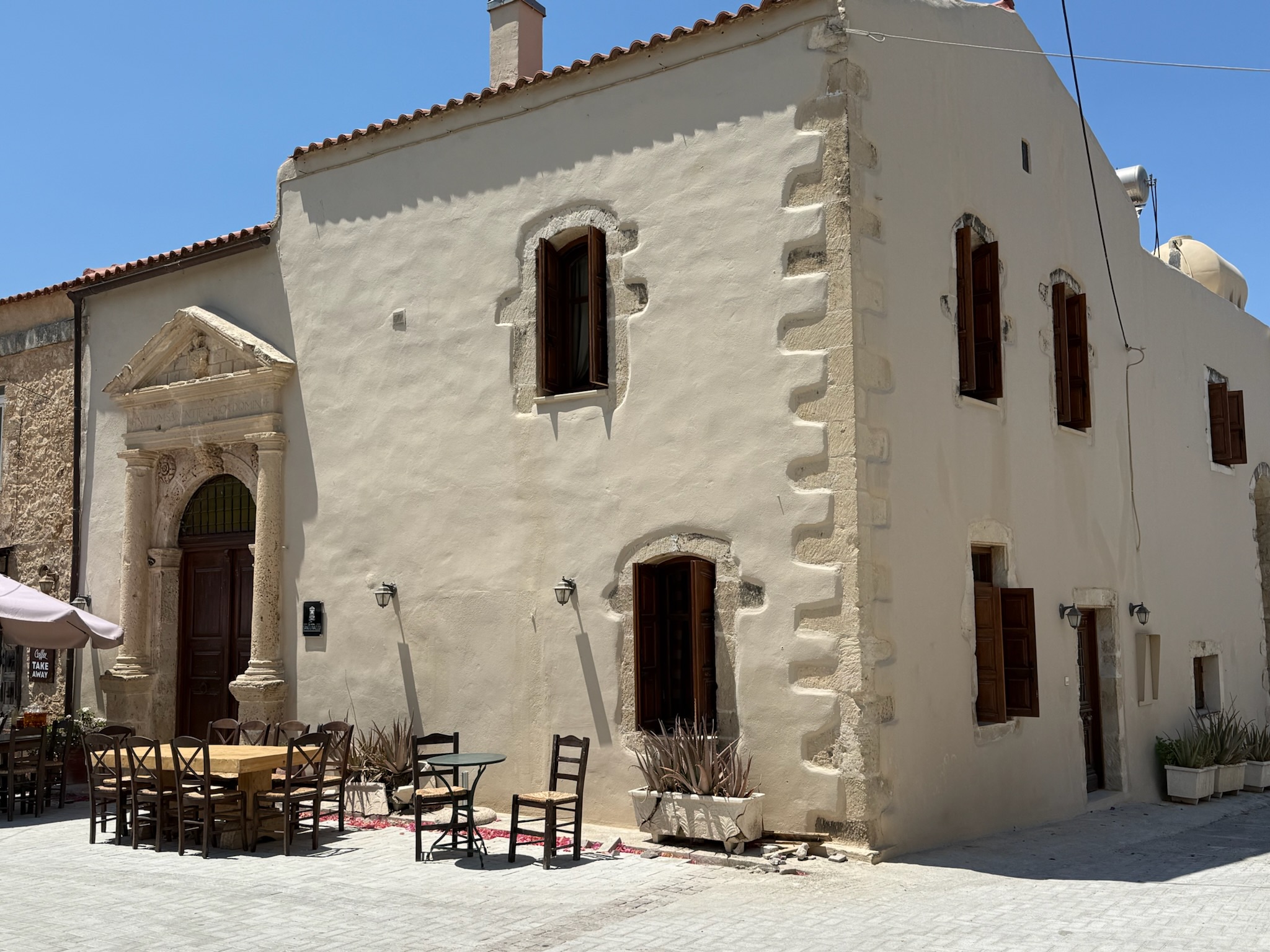
Casa Sanguinazzo
Amnatos, Crete, Greece
Casa Sanguinazzo is an impressive stone mansion of historic significance, linked to a son of the largest of the late 16th century's emergent Cretan noble families, Zorzi Sanguinazzo, from whom the mansion gets its name. Constructed in the decade prior to the laying of the foundations of Rethymno's famous fortezza, the mansion's entrance portico is famous on the island and is of noted importance, with its Latin inscription: "Initium Sapientiae Timor Domini" (In English: "Fear of the Lord is the beginning of wisdom"), taken from Psalms 111:12. Zorzi Sangionazzo's initials appear either side of the family crest in the upper pedament of the portico.
Rethymno is known for the portals which were built when the town was reconstructed after having been raided by the Ottomans in 1571. A similar portal can be found in the village of Amnatos, two miles before Moni Arkadi...
History
Official Recognition
The Government Gazetta of The Kingdom Of Greece (September 1986) in the Ministerial Decisions and Approvals section, contains the sub-section: On the characterisation of archeological sites and historical monuments... We characterise as archeological sites and declare as Historical Monuments, as follows:' A. Archeological Sites a) Second Region of Classical Antiquities ... (d) In the village of Amnatos 1. A Venetian doorway with the words 'INITIUM SAPIENTIAE TIMOR DOMINI'
The Famous Inscription's Origin
The inscription of Casa Sanguinazzo's portico is identical to that placed by Pope Sixtus V (1585 - 1590) above the entrance to Archiginnasio della Sapienza in Rome. The Archiginnasio della Sapienza (literally 'old gymnasium of wisdom') was founded by Pope Boniface VIII (1294 - 1303) with the name of Studium Urbis and it was located in the Trastevere neighbourhood of Rome. During the 15th century, emphasising its growing importance, it was moved to the more central Rione Sant'Eustachio locale and it became known as the Sapienza due to the inscription.
Venetian Rethymno
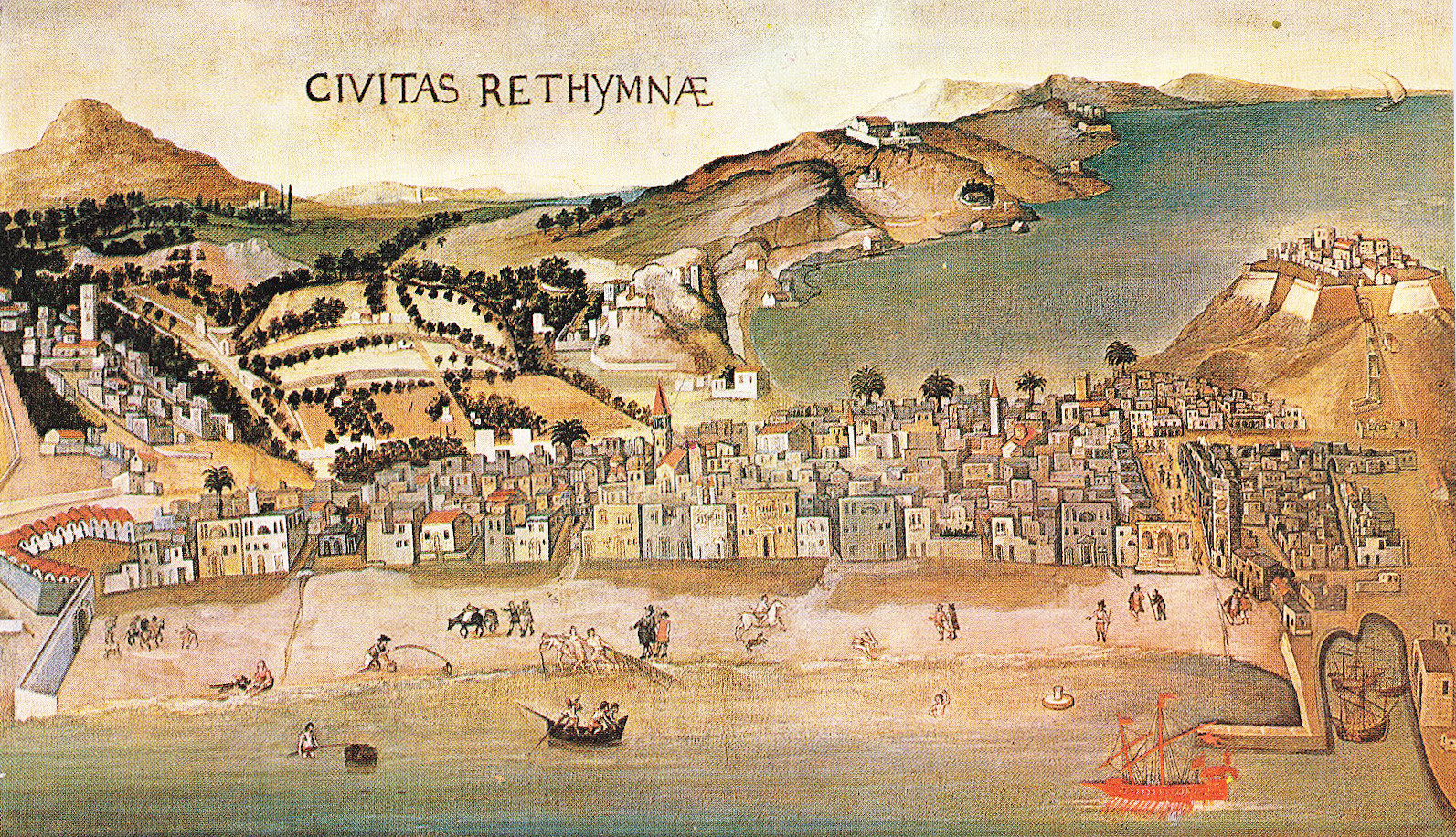
Anonymous mid-17th century painting - Houses on the Rethymnon seafront road, c1620-1656
A well-known painting by an anonymous painter currently hangs in Rethymno's City Hall. Painted in the first half of the 17th century, it depicts the beautiful mansions of Rethymno's seafront. One of them, painted a distinctive ochre, at the centre of the seafront, stands out - having such common elements in the layout of its facade with a house standing today at 154 Arkadiou Street, Rethymno, that it is reasonable to think that the artist had that house in mind when they painted. The beauty and desirability of these mansions is further underlined by the interesting story of a Cretan nobleman named Giacomo Sanguinazzo - presumably a close relative of the Zorzi Sanguinazzo of the Amnatos mansion. Giacomo, one of the most prominent and well-off members of Rethymno society, since he was able to lend to even the public treasury, had, according to the sources, the most beautiful house in Rethymno; this was located on the sandy beach. However when, in November 1620, the Venetian Giacomo Da Riva came to the city to take over the duties of the Councillor, he took possession of the mansion of his namesake Giacomo Sanguinazzo, who was then of advanced age, evicting Sanguinazzo by force and becoming the owner of the house. This incident is also indicative of the relative power of the Venetian nobles from the metropolis versus the local population, even if they were Cretan nobles like Sanguinazzo. Whether this residence can be definitively identified as the house on Arkadiou Street is an open question. Source: Virtual time travels in Crete - Venetian Period - The city of Rethymno (Byzantine-Venetian Rethymnon) by Markos Giannoulis, Theodoros Metochites.
Amnatos /Arkadi In Historic Literature
'I returned to the convent; and on the twenty-eighth travelling northward, passed through the villages of Amnato, and went to the mouth of the river Stavromene, on both sides of which there are ruins, and the place is called Airio. We went a mile southwards to the rich convent of Arsani, which is subject only to the patriarch of Constantinople; it is pleasantly situated, and the estate that belongs to it produces some of the best wines and oil in all Candia [Crete].' - Richard Pococke, "A description of the East, and some other countries", 1745. 'At the end of four hours of gradual ascent from Retimo [Rethymno], we reached the large village of Amnato, and turned round to take a last view of the town on its conspicuous peninsula, beyond which lay a wide expanse of the northern sea. [...] From this point we descended towards a wide and deep gorge, along the steep side of which the path leads, and as it gradually contracts the scenery becomes fine, from the red limestone caverns, and the trees which fringe the bed of the stream. Near the head of this, where the valley is wildest, we cross it by a bridge, and mounting steeply, find ourselves on an exposed plateau where, near the edge of the ravine and fronted by a conspicuous group of stone pines, stands the monastery of Arkadi.' - Henry Fanshawe Tozer, "The Islands of The Aegean Sea", published 1890, (though Tozer began his travels in 1874)